
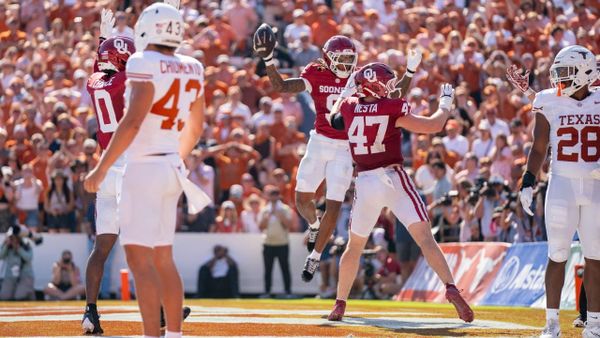
DALLAS — Texas entered the Cotton Bowl as the No. 1 team in the country. Three hours later, the Longhorns walked away with their first loss of the season, undone by two late Arch Manning interceptions and an Oklahoma field goal as time expired.
The Sooners stunned Texas 27-24 on Saturday in another dramatic chapter of the Red River Rivalry, overcoming a 10-point halftime deficit and capitalizing on a series of costly Longhorns mistakes to secure their first victory over Texas since 2023.
For Texas, the defeat was particularly frustrating because of how much of the game appeared to be within its control.
"I am frustrated," Texas Head Coach Steve Sarkisian said. "Because we are working at it. It's not for a lack of effort... but it clearly has not been good enough."
The Longhorns outgained Oklahoma 382-238 in total offense, held the Sooners to limited production for significant stretches and entered halftime with a 17-7 advantage. But offensive inconsistency, special teams breakdowns and turnovers allowed Oklahoma to remain within striking distance before delivering the decisive blow.
Manning finished 19-of-31 passing for 260 yards and three touchdowns, but his two fourth-quarter interceptions ultimately overshadowed an otherwise productive afternoon.
The loss dropped Texas to 4-1 overall and 1-1 in Southeastern Conference play, while Oklahoma improved to 3-2 and 1-1 in the SEC.
Texas Squanders Early Control
The Longhorns appeared poised to extend their unbeaten start after building a double-digit halftime lead behind Manning and an offense that found success through the air.
Manning connected with Cam Coleman on a 41-yard touchdown pass as Texas established early momentum. Defensively, the Longhorns largely contained Oklahoma quarterback John Mateer and prevented the Sooners from consistently sustaining drives.
But even as Texas controlled much of the first half, warning signs began to emerge.
Oklahoma's Danny Okoye blocked a Longhorns punt, which Dakoda Fields recovered and returned for a touchdown. The special teams score kept the Sooners competitive despite their offensive struggles and prevented Texas from building a more commanding advantage.
The problems became more pronounced after halftime.
“They wanted to win today more than anybody, believe me," Sarkisian said of his team.
Texas punted on its first four possessions of the second half, allowing Oklahoma to gradually work its way back into the game. The Longhorns struggled to establish offensive rhythm, and their inability to sustain drives repeatedly put pressure on a defense that had performed well for much of the afternoon.
Oklahoma running back Lloyd Avant helped spark the comeback with a 42-yard run that set up Tate Sandell's 53-yard field goal, cutting the deficit to 17-10.
Later, a Texas roughing-the-passer penalty negated an interception and extended another Oklahoma possession. Avant eventually scored from two yards out, tying the game at 17.
What had been a controlled first half for Texas had become a tightly contested rivalry game entering the fourth quarter.
The contrast was significant. Texas had moved the football more effectively overall, but Oklahoma was finding ways to turn limited opportunities into points.
For the Longhorns, the inability to capitalize on their statistical advantage would become the defining problem of the afternoon.
Manning's Turnovers Change the Game
Texas' offensive struggles reached a critical point early in the fourth quarter when Manning threw an interception to Oklahoma defensive back Peyton Bowen.
Bowen returned the pass 42 yards for a touchdown, giving the Sooners a 24-17 lead with 10:07 remaining.
The play marked a dramatic reversal for a Texas offense that had entered the game with the nation's top ranking and considerable expectations surrounding its quarterback.
Still, Manning responded with one of his strongest sequences of the afternoon.
He connected with Coleman for a 42-yard gain before finding Jermaine Bishop Jr. on a 15-yard touchdown pass, tying the game at 24 with 6:32 remaining.
The drive demonstrated Manning's ability to recover from adversity and make difficult throws under pressure. It also gave Texas an opportunity to regain control after surrendering its halftime lead.
But the Longhorns could not finish the job.
With the game tied and less than two minutes remaining, Texas faced fourth-and-2 at the Oklahoma 35-yard line.
Sarkisian elected to send out kicker Gianni Spetic for a 53-yard field goal attempt rather than keep his offense on the field.
Spetic missed wide right, leaving the game tied and giving Oklahoma another opportunity.
The decision was a consequential one for Sarkisian. A successful kick would have given Texas the lead, while converting the fourth down could have allowed the Longhorns to continue their drive and potentially leave Oklahoma with less time to respond.
Neither outcome was guaranteed, and the field goal attempt was within the range Texas was willing to try. But the decision placed the game in the hands of a kicking unit that had already experienced special teams difficulties.
Texas' defense subsequently forced another Oklahoma punt, returning possession to Manning with 54 seconds remaining.
The Longhorns had one final chance to escape Dallas with their unbeaten record intact.
Instead, Manning threw his second interception of the quarter, this time to Courtland Guillory with 19 seconds remaining.
The turnover gave Oklahoma possession at its own 39-yard line and transformed what appeared headed toward overtime into an opportunity for the Sooners to win in regulation.
Mateer completed consecutive passes to Isaiah Sategna III for gains of 13 and 20 yards, moving Oklahoma into field goal range.
Sandell then connected from 47 yards as time expired, completing the comeback and sending the Oklahoma sideline into celebration.
Special Teams, Offensive Execution Cost Longhorns
Although Manning's interceptions provided the most visible turning points, Texas' defeat cannot be attributed solely to its quarterback.
The Longhorns finished with 144 more total yards than Oklahoma, yet that advantage did not translate into enough points to secure a victory.
Texas' offense produced explosive passing plays and three touchdowns through the air, but its inconsistency between those moments prevented the Longhorns from maintaining control.
The four consecutive punts to begin the second half were particularly damaging.
Each stalled possession gave Oklahoma another opportunity to close the deficit while forcing the Texas defense back onto the field. Even without consistently moving the football, the Sooners were able to remain competitive because Texas failed to extend its lead.
Special teams compounded those problems.
The blocked punt returned for a touchdown gave Oklahoma seven points without requiring its offense to take the field. The missed field goal in the final minutes represented another lost opportunity, this time with the game tied and the outcome hanging in the balance.
Oklahoma also benefited from Bowen's interception return for a touchdown, meaning 14 of its 27 points came directly from defensive and special teams scores.
That distinction helps explain how Texas could comfortably outgain Oklahoma and still lose.
The Sooners did not need to dominate offensively. They needed to capitalize on Texas' mistakes, protect themselves from falling too far behind and execute when the game presented an opportunity.
They accomplished all three.
Texas, meanwhile, struggled to convert its advantages into sustained control.
For Sarkisian, the result raises questions about situational execution, particularly the offense's second-half struggles and the team's ability to protect a lead against a rival that was generating limited offensive production.
Manning's performance will also face scrutiny, though the numbers reveal a more complicated afternoon than the two interceptions alone suggest.
The quarterback accounted for all three Texas touchdowns through the air and engineered the fourth-quarter drive that tied the game. But his mistakes directly contributed to Oklahoma's go-ahead touchdown and its final opportunity to win.
In a rivalry decided by three points, those possessions proved decisive.
Loss Raises Questions About Texas' Championship Pursuit
The defeat represents the first major setback of a season that began with Texas positioned among the leading national championship contenders.
The Longhorns entered Saturday atop the rankings, carrying the expectations that accompany a program seeking to compete for both an SEC championship and a College Football Playoff berth.
One loss does not eliminate those possibilities.
But the nature of Saturday's defeat presents concerns that Texas will need to address as conference play continues.
The Longhorns demonstrated they could generate explosive offensive plays and limit an opponent's production. What they failed to demonstrate was the consistency required to turn those advantages into a victory.
Against Oklahoma, the consequences were immediate.
For Manning, the challenge will be responding to a difficult fourth quarter without allowing the turnovers to overshadow the progress he has made as a passer.
For Sarkisian, the responsibility extends beyond quarterback play. Texas must improve its special teams execution, sustain offensive drives and avoid the kinds of penalties and missed opportunities that helped Oklahoma erase a double-digit deficit.
The Sooners, meanwhile, leave Dallas with a signature victory under head coach Brent Venables and renewed momentum following an uneven start to the season.
Oklahoma's victory was its first over a No. 1-ranked opponent since defeating Missouri in 2007, adding another memorable result to one of college football's most storied rivalries.
Texas will have opportunities to recover, but Saturday's result changes the conversation surrounding the Longhorns.
The nation's No. 1 team did not lose because Oklahoma consistently outplayed it on offense.
Texas lost because it failed to finish drives, protect the football and capitalize on the opportunities it created.
And in the Red River Rivalry, those mistakes were enough to turn a potential statement victory into a stunning defeat.
Written by
